


Calculating the amount of fabric needed for a patchwork quilt is a crucial step in the quilting process. As a supplier of patchwork quilts, I've encountered numerous customers who are eager to understand this calculation. In this blog, I'll guide you through the process, ensuring you have all the information you need to estimate the fabric requirements accurately.
Understanding the Basics of Patchwork Quilts
Before delving into the calculations, it's essential to understand what patchwork quilts are. Patchwork quilts are created by sewing together small pieces of fabric, known as patches, to form a larger design. These patches can vary in size, shape, and color, allowing for endless creative possibilities. The most common shapes used in patchwork quilting are squares, rectangles, triangles, and hexagons.
Factors Affecting Fabric Requirements
Several factors influence the amount of fabric needed for a patchwork quilt. These include:
- Quilt Size: The size of the quilt you want to make is the most significant factor. Common quilt sizes include twin, full, queen, and king. Larger quilts naturally require more fabric.
- Patch Size and Shape: The size and shape of the patches you use will also impact the fabric amount. Smaller patches may require more individual pieces, increasing the overall fabric consumption.
- Seam Allowance: Seam allowance is the extra fabric you leave around each patch to sew them together. A standard seam allowance in quilting is ¼ inch, but this can vary depending on your preference and the project requirements.
- Design Complexity: Intricate designs with multiple colors and patterns may require more fabric to achieve the desired look.
Calculating Fabric for Square Patches
Square patches are the most straightforward to work with when calculating fabric requirements. Here's a step-by-step guide:
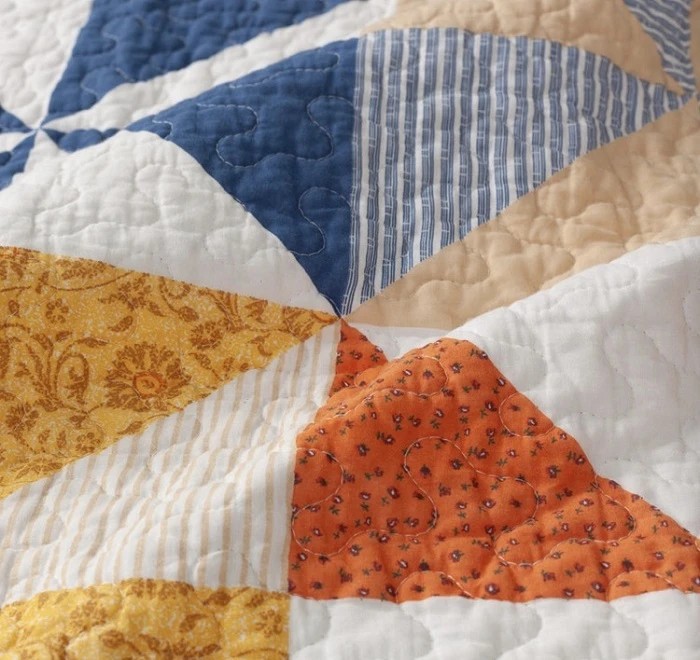

- Determine the Quilt Size: Decide on the finished size of your quilt. For example, let's say you want to make a twin-sized quilt that measures 68 inches by 86 inches.
- Choose the Patch Size: Select the size of the squares you want to use. For this example, let's use 4-inch squares.
- Calculate the Number of Patches: Divide the length and width of the quilt by the patch size to determine the number of patches needed in each direction. For our twin-sized quilt:
- Length: 68 inches ÷ 4 inches = 17 patches
- Width: 86 inches ÷ 4 inches = 21.5 patches. Since you can't have half a patch, round up to 22 patches.
- Total number of patches: 17 patches × 22 patches = 374 patches
- Account for Seam Allowance: Add the seam allowance to the patch size. With a ¼-inch seam allowance, each patch will effectively be 4.5 inches (4 inches + 0.5 inches for the seam allowance on both sides).
- Calculate the Fabric Width: Most quilting fabrics are 42 to 44 inches wide. For our calculation, let's assume a fabric width of 42 inches.
- Determine the Number of Patches per Row: Divide the fabric width by the effective patch size. 42 inches ÷ 4.5 inches = 9.33. Round down to 9 patches per row.
- Calculate the Number of Rows: Divide the total number of patches by the number of patches per row. 374 patches ÷ 9 patches per row = 41.56. Round up to 42 rows.
- Calculate the Fabric Length: Multiply the number of rows by the effective patch size. 42 rows × 4.5 inches = 189 inches. Convert this to yards by dividing by 36 (since there are 36 inches in a yard). 189 inches ÷ 36 inches/yard = 5.25 yards.
Calculating Fabric for Rectangular Patches
The process for rectangular patches is similar to that of square patches, but with an additional step to account for the different dimensions. Here's how to do it:
- Determine the Quilt Size and Patch Dimensions: Let's say you want to make a full-sized quilt that measures 80 inches by 90 inches and use 3-inch by 6-inch rectangles.
- Calculate the Number of Patches: Divide the length and width of the quilt by the corresponding patch dimensions.
- Length: 80 inches ÷ 6 inches = 13.33. Round up to 14 patches.
- Width: 90 inches ÷ 3 inches = 30 patches.
- Total number of patches: 14 patches × 30 patches = 420 patches.
- Account for Seam Allowance: Add the seam allowance to each dimension of the rectangle. With a ¼-inch seam allowance, each rectangle will be 3.5 inches by 6.5 inches.
- Calculate the Fabric Width and Orientation: Decide whether to cut the rectangles with the long side parallel to the fabric's selvage (the finished edge of the fabric) or perpendicular. This will affect the number of patches you can get from each row.
- If cutting with the long side parallel to the selvage:
- Divide the fabric width by the short dimension of the rectangle. 42 inches ÷ 3.5 inches = 12 patches per row.
- Divide the total number of patches by the number of patches per row. 420 patches ÷ 12 patches per row = 35 rows.
- Calculate the fabric length: 35 rows × 6.5 inches = 227.5 inches. Convert to yards: 227.5 inches ÷ 36 inches/yard = 6.32 yards.
- If cutting with the long side perpendicular to the selvage:
- Divide the fabric width by the long dimension of the rectangle. 42 inches ÷ 6.5 inches = 6.46. Round down to 6 patches per row.
- Divide the total number of patches by the number of patches per row. 420 patches ÷ 6 patches per row = 70 rows.
- Calculate the fabric length: 70 rows × 3.5 inches = 245 inches. Convert to yards: 245 inches ÷ 36 inches/yard = 6.81 yards.
- If cutting with the long side parallel to the selvage:
Calculating Fabric for Triangular Patches
Triangular patches are a bit more complex to calculate due to their shape. The most common type of triangle used in quilting is the right-angled triangle. Here's how to calculate fabric for these triangles:
- Determine the Quilt Size and Triangle Dimensions: Let's say you want to make a queen-sized quilt that measures 88 inches by 102 inches and use 3-inch right-angled triangles.
- Calculate the Number of Triangles: Triangles are often used in pairs to form squares or other shapes. First, calculate the number of square units needed for the quilt. For simplicity, let's assume you're using the triangles to form 6-inch squares (two 3-inch triangles sewn together).
- Divide the length and width of the quilt by the square size.
- Length: 88 inches ÷ 6 inches = 14.67. Round up to 15 squares.
- Width: 102 inches ÷ 6 inches = 17 squares.
- Total number of squares: 15 squares × 17 squares = 255 squares.
- Since each square is made up of two triangles, the total number of triangles needed is 255 squares × 2 triangles per square = 510 triangles.
- Divide the length and width of the quilt by the square size.
- Account for Seam Allowance: Add the seam allowance to the triangle dimensions. With a ¼-inch seam allowance, each triangle will effectively be 3.5 inches.
- Calculate the Fabric Width and Cutting Method: Triangles can be cut from the fabric in different ways. One common method is to cut them from strips.
- Cut strips that are the height of the triangle plus the seam allowance. For our 3.5-inch triangles, cut 3.5-inch strips from the fabric.
- Determine the number of triangles you can get from each strip. The number will depend on the width of the fabric and the cutting angle.
- Calculate the number of strips needed based on the total number of triangles.
- Finally, calculate the fabric length by multiplying the number of strips by the strip width.
Additional Considerations
- Backing and Batting: Don't forget to account for the backing fabric and batting. The backing should be slightly larger than the quilt top to allow for wrapping around the edges. A common rule of thumb is to add 8 to 10 inches to each dimension of the quilt top for the backing. Batting comes in various thicknesses and sizes, so choose one that suits your project.
- Fabric Waste: There will always be some fabric waste when cutting patches, especially when working with irregular shapes. It's a good idea to add an extra 10% to 15% to your calculated fabric amount to account for this waste.
Conclusion
Calculating the amount of fabric needed for a patchwork quilt requires careful planning and consideration of several factors. By following the steps outlined in this blog, you can estimate the fabric requirements accurately and avoid running out of material during your project.
As a patchwork quilts supplier, we offer a wide range of high-quality fabrics in various colors, patterns, and textures to suit your creative needs. Check out our Blue Patchwork Quilt, Pinwheel Patchwork Cotton Quilt Set, and Patchwork Printed Quilt Set for inspiration.
If you have any questions or need further assistance with your patchwork quilt project, please don't hesitate to contact us. We're here to help you bring your quilting vision to life.
References
- "Quilting for Beginners: A Step-by-Step Guide" by Jane Doe
- "The Complete Book of Patchwork and Quilting" by John Smith