


Patchwork Quilts
Shanghai Smike International Trading Co. Ltd. was established in 2010, located in Shanghai, China. Specialized in exporting of quilts, bedspreads, duvet covers, sheet sets, comforter sets, blankets, toys, etc. We have rich experience in home textiles. We have many customers from wholesalers to retailers all over the world, such as Dolz, JHL, MH, Luhta, and Babyelegance.
When stepping into home textiles, SMIKE is devoted to building the integrated service from development, and production to after-sale service. We could customize according to every different requirement and develop new products with our professional design team.
SMIKE enjoys a good reputation in the world of our competitive price, perfect after-sale service, and strict QC quality control systems. We have joined some exhibitions like Frankfurt Fair, Canton Fair, East China Fair In Shanghai, and many other fairs all over the world to receive new and old customers. We are acquainted with the market and pay close attention to the tendency of fashion. Our management idea is " WIN-WIN COOPERATION".If we are lucky to have the opportunity to cooperate with you, we believe Smike will be in your good partner list.
Why choose us?
Rich experience
We have an embroidery pattern and printing pattern design team with more than 10 years of design research on home textiles. Our designs are recognized by customers from various countries.
Professional solution
With rich experience and one-to-one service, we can help you choose products and answer technical questions.
Quality control
Our quality inspection team has established a strict quality control system to conduct comprehensive inspections of products, discover and solve problems promptly, and ensure the quality of products or services.
Global shipping
We have a very professional and stable transportation team that can quickly arrange delivery and transportation, so that you can receive the goods you ordered as quickly as possible. Can reduce your time cost.


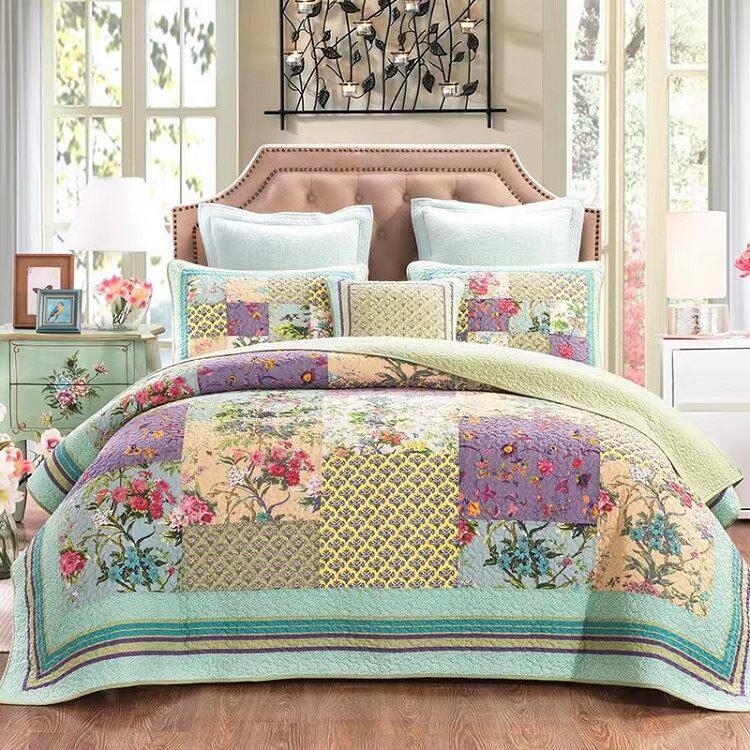
A patchwork quilt is a quilt in which the top layer may consist of pieces of fabric sewn together to form a design. Originally, this was to make full use of leftover scraps of fabric, but now fabric is often bought specially for a specific design. Fabrics are now often sold in quarter meters (or quarter yards in the United States). A "fat quarter" is one square meter (or one yard by the width of the fabric, typically 42–44") folded into four and cut along the folds, thus giving a relatively square piece of fabric 50 cm on a side, as opposed to buying a quarter of a meter off the roll, resulting in a long thin piece that is only 25 cm wide.
Today, quilting is no longer practiced to satisfy economic or social needs, but for expression and enjoyment. Patchwork is not longer simply a form of frugality, but rather another form of art. Although quilts are still sometimes made from fabric scraps, the quilt maker is more likely to use the scraps to recreate the charming look of old quilts or to commemorate an event, rather than out of necessity.
Quilting is now used as a creative and inspirational form of craft. Having a long history, quilting has shown itself to be admirably versatile and its ability to change and adapt is a hallmark of a successful craft.
Many people, today, used quilting as a hobby because they find it fun, gratifying and enriching. Quilting offers them an opportunity to express their creativity and helps to enhance their lives. Most people enjoy the process of choosing or designing a project, the process of selecting the fabrics and the satisfaction of creating something unique and special.
It gives them an opportunity to experiment with color, design and texture. The completed piece of quilt gives the maker a great sense of achievement and delight. Most people engage in quilting because they want a creative experience and an emotional expression. It is no wonder that some people find it healing. Stressed mothers of young children, exhausted caregivers of ill parents, wearied working women and men seeking a creative outlet often find the process of making something soft and warm, like quilt, is more restorative than the usage of any kind of available drugs.
As quilts provide warm and comfort, they are used for clothing and bed coverings. There are those which are kept as attractive works of art. They have been showcases for the talents and skills of their creators. The range of quilted items, nowadays, has expanded to include placemats, wall hangings, cushion covers, table runners, bonnets, diaper totes, eyeglass cases, makeup bags and hanger covers.
Making quilts today is easier than you may have ever imagined. The making of quilts does not require any special skills, just a general knowledge of sewing. If you can sew a button or mend a hem, you can certainly make a quilt. Quilting is simply using a technique to stitch together layers of fabric using a decorative pattern to create a variety of beautiful and practical objects.
A completed quilt is actually a creatively stitched together sandwich of fabric and batting. The basic equipment for quilting include needles, pins, thread, scissors, thimble, beeswax and a frame or hoop to quilt on. Other necessities are a long ruler, masking tape, drawing paper and a marker for transferring quilt patterns onto fabric. Although machine techniques may have replaced the tedious hand sewing one, modern quilt makers still take inspiration from old quilts and try to adapt those designs and techniques to todays lifestyles.
It is important that while working on selected quilting patterns, a quilt maker should not just replicate the patterns and colors shown in the samples but also to adapt the patterns to his or her own color preferences and ideas. He or she should attempt to create his or her own unique designs and try out new techniques. In this way, he or she can make progress by gaining new technical skills as well as new insights into the design process.
Cotton is the most commonly used for patchwork and the easiest fabric to find. Although cotton cloth is sold in various weights and qualities, we recommend 100% cotton fabric as it has a great weave and is easy to work with.
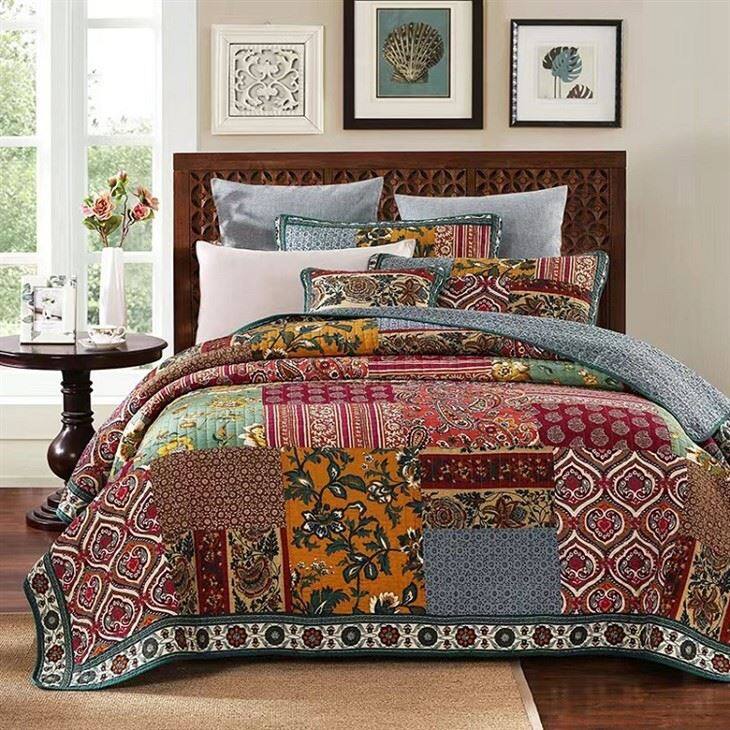
What Supplies and Equipment do I Need to Patchwork Quilt
Patchwork quilting originated with the desire to use leftover scraps of worn garments to fashion new projects economically, so you can start with whatever fabric pieces you have on hand.
However, some basic materials will make your introduction to patchwork even easier:
Machine: You can use almost any sewing machine for patchwork and quilting.
Fabric: The best fabric for learning patchwork is 100% cotton broadcloth or calico, often called quilter's cotton. It may be solid or printed. For your first block, look for fabric without geometric repeats: no stripes, checks, or plaids.
Thread: Many quilters swear by 100% cotton thread for piecing, but modern polyester all-purpose threads are also a good choice. Choose an all-purpose weight or finer thread so the thread bulk doesn't become an issue in your accuracy. Please avoid waxed hand-quilting threads; they are meant to be used for hand-quilting and are too bulky for piecing. In addition, the waxy coating may cause problems for your machine. As for thread color, a beige or gray thread will blend into most fabrics so you can use just one thread color for your piecing. Choose white thread for the lightest colors or black thread for a dark quilt top.
Needles: Use a sharp-pointed needle in size 11 or 12 for piecing. Specialty quilting needles are available for the quilting part of the process but aren't needed for piecing.
Rotary cutter, ruler, and mat: This tool combo revolutionized the quilting world in the late 20th century. It eliminates the need to make templates from paper or cardboard and increases the accuracy and speed of cutting. Choose a 45mm cutter to start and a mat at least 12" x 18". You need only one or two rulers initially; 8 1/2" x 12" and 12" x 12" are two basic sizes that will allow you to cut most patches. Specialty rulers are everywhere, and you may choose to build a collection, but rectangular and square rulers are versatile enough for most patterns.
Scissors: You can make an entire quilt without lifting a pair of scissors, but having a small pair of thread snips near your sewing machine is very helpful. When you graduate to curved piecing or appliqué, scissors will be an essential part of your toolbox, but even then, a 28mm rotary cutter might be your choice.
Pins: You'll want straight pins to temporarily hold patches together as you sew. Later, you may also use safety pins to baste the layers of your quilt together for quilting.
1/4" quilting foot: While your all-purpose presser foot may be able to accurately gauge a 1/4" seam allowance, the 1/4" foot makes it much more manageable.
Iron and ironing surface: Many quilters keep a small iron and pressing mat beside their machines to press each seam without constantly getting up to walk to the ironing board.
Other tools: There are a few different tools that are nice to have on hand for some piecing projects: marking tools, especially a removable marker or chalk; regular pencils; spray starch or a substitute; a wooden iron for pressing seam allowances without using a hot iron.
Timeless Art Patchwork Quilts
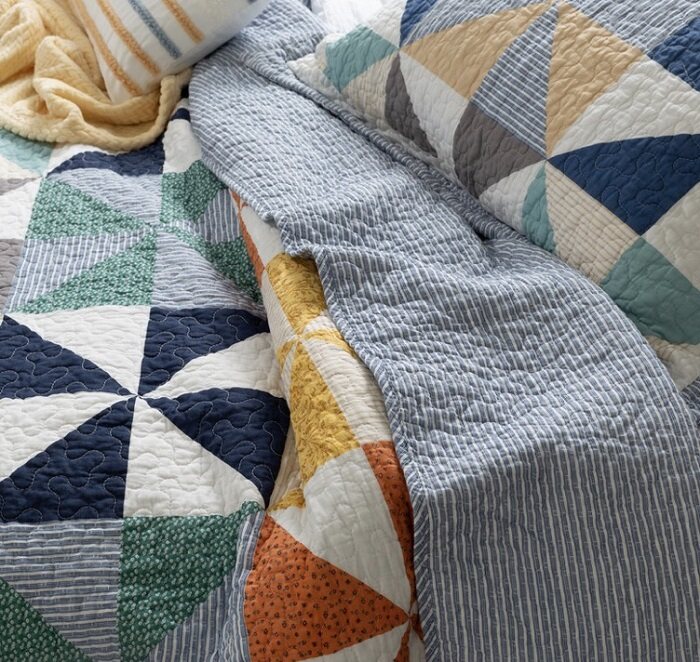
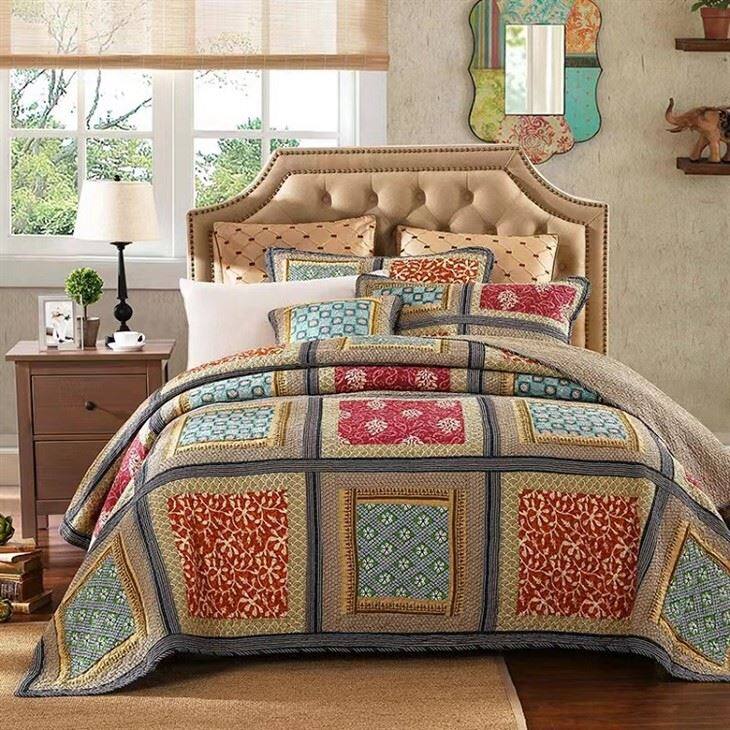
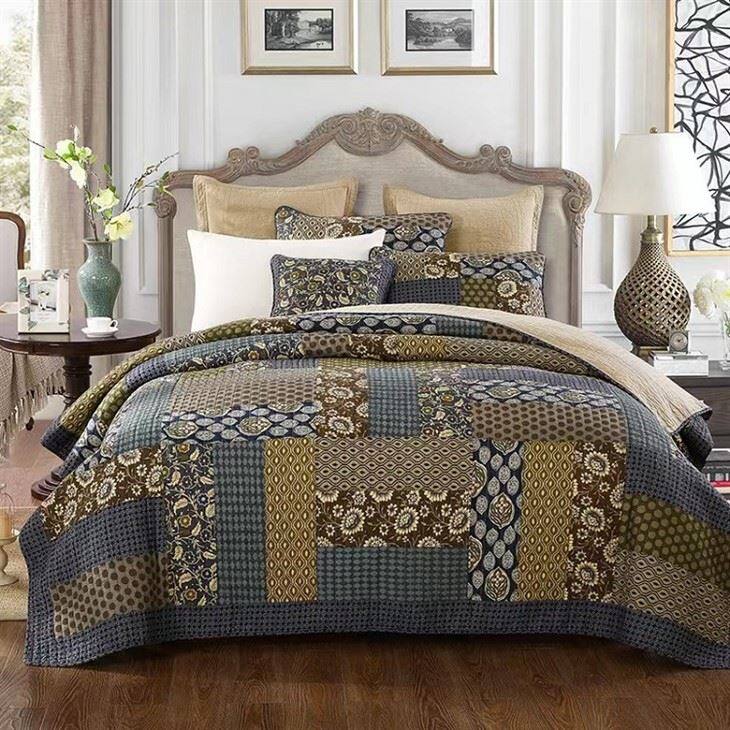
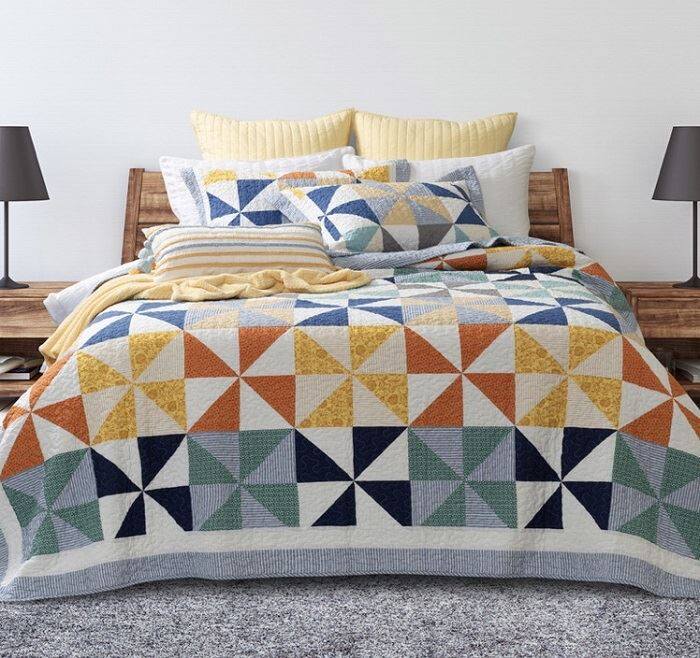
Patchwork quilts are those quilt tops whose design is composed of separate elements sewn together (pieced). Either new fabric or carefully saved scraps are cut into pieces and sewn together to form designs.
The pieces, or patches, are usually simple geometric shapes: squares, triangles, rectangles, diamonds, hexagons, and circles. The pieces must be precisely cut and sewn together in order for the edges to fit together exactly.
Small pieces are typically joined together into easily handled blocks that are then sewn into strips. The strips are joined to form the completed quilt top. Sometimes a border is added.
The block-style patchwork design was the result of a functional approach to the solution of several problems faced by colonial and pioneer quilters.
Bed-covers had to made, and in quantity -- drafty houses and dugout houses carved into the sod of the prairie required many quilts to provide warmth during the bitter cold winters.
Money was scarce, and whole cloth was expensive. So, from seemingly worthless scraps of cloth, some as small as 1 inch, salvaged from clothes-making and worn out cloth articles, pioneer women pieced together usable pieces of fabric that became one side of the quilt.
The block-style technique in which pieces are cut into geometric, straight-edged forms was itself the most efficient method, in terms of both time and material, for using surplus fabric and joining it together. Backs of patchwork quilts were frequently pieced, too.
The block-style method was also a time-saving device in which individual, identical blocks can be pieced one by one and later joined together. It's also space-saving, which was critical considering the cramped quarters of early American rural living. Additionally, a patchwork quilt was often a record of a family’s history, incorporating bits of garments and other household textiles.
There are two categories of block-style patchwork. Quilts in which the blocks can each stand alone in terms of the design, and quilts in which the blocks have been joined together as integral parts of the overall design.
Quilters developed a multitude of patchwork patterns that, because of their great popularity, became part of the folk tradition. These patterns have colorful names that often reflect elements of everyday life, such as, Log Cabin, Flying Geese, Drunkard’s Path, Lone Star, Bear’s Paw, Broken Dishes, and Windmill.
How to Maintain Patchwork Quilts
Quilts on display in your home—and even those in storage—are susceptible to dust, dirt, stains, and odors. Here’s how to freshen your quilts.
Dust and dirt: Shake a quilt outdoors to loosen dust. Use a lint roller to pick up dust, pet hair, or dirt. For stubborn dust and dirt, cover the end of a vacuum hose with a nylon pantyhose and gently draw the hose over the quilt surface.
Odors: Spread a clean bedsheet on the grass out of direct sunlight. Lay your quilt atop the sheet for a few hours. If the quilt is small, you can hang it from a clothesline instead. For stubborn odors, lightly spray the quilt with distilled white vinegar and let it air-dry.
Stains: Mix a few drops each of liquid laundry detergent and water. Use a clean cloth or soft toothbrush to gently scrub the stain with the mixture. (You also can use baby shampoo.) Blot with a clean damp cloth. Repeat until the stain is removed and let it air-dry.
Washing quilts can cause fabrics to fade and can be abrasive to thread and fibers so the less washing the better. If a quilt is used only in certain seasons or for a holiday, wash it once a year or before you put it back into storage. Quilts that get everyday use should be washed seasonally. Here are two ways to wash a quilt.
By machine: Use cold water, mild detergent, and a delicate or hand-wash cycle. It’s best to wash quilts by themselves in case the fabric dye runs.
By hand: Add cold water to a clean tub, sink, or plastic container and thoroughly dissolve detergent in the water before adding the quilt. Gently agitate the quilt to release dirt. Rinse the quilt by draining and refilling the tub as many times as needed. Press excess water out of the quilt before removing it from the tub. If the quilt is especially heavy, use a large towel or cotton sheet to lift the quilt out.
Before drying your quilt, ring as much excess water from it as you can. Either gently squeeze it, starting on one end and working to the other, or run it through a quick spin cycle in your washing machine. Here are two ways to dry a quilt.
By machine: To avoid shrinkage, tumble-dry your quilt on low heat, taking it out of the dryer while it’s still damp. Let it finish air-drying.
Air-dry: Lay the quilt flat on a layer of towels or large drying rack. You can use a fan to speed up the drying process. Because wet quilts are heavy, it’s best not to hang them from a clothesline or shower curtain rod, which can weaken or tear the seams at the point of suspension.
Our Factory
We are happy to cooperate with the customer to develop new items to meet the market, and also we share new designs or ideas with the customer, making samples to test the market. In the production period, our QC visits the factory to monitor the quality and will point out and correct it as soon as find the quality problem. We never encountered big quality problems, and as soon as the customer finds some quality problem, we have and will do our best to solve this to satisfy the consumers.


FAQ
As one of the leading patchwork quilts manufacturers and suppliers in China, we warmly welcome you to buy high-grade patchwork quilts for sale here from our factory. All custom made home textiles are with high quality and competitive price.
Rustic Patchwork Quilts, Chelsea Cotton Patchwork Quilt, Star Patchwork Quilt